Skip to content

Family Hubs and Early Year settings are smokefree


Introduction

Welcome to the training module for Smokefree Family Hubs and Early Year Settings. The following pages provide information about why we need to work together to reduce smoking prevalence in Devon. You will learn why it is essential that we promote smokefree sites and how we can all help to support smokers that we come into contact within these settings.

  • You can either complete the module section by section, or tackle it all in one go. It should not take you more than 20 minutes to complete.
  • Select the subheadings on the vertical navigation bar on the left hand side of the page to progress, or alternatively use the button on the bottom right of each page.
  • At the end of the training, you will need to access the short assessment (10 short questions). On successful completion of the test you will be sent a Certificate of Completion.

Your completion of the programme will be logged with Public Health, Devon County Council. If you have difficulties accessing this programme please contact Public Health on publichealth-mailbox@devon.gov.uk

Aims of the module

During this session you will learn the following:

Health harms of tobacco

  • The risks of smoking and secondhand smoke

Smokefree sites

  • Why our sites need to be smokefree
  • What role you can play in keeping the site smokefree

How to support smokers that you come into contact with

  • What brief advice interventions are
  • Why brief advice is important
  • How best to carry it out brief advice
  • What support is available to help smokers to quit

Why Children’s Centres and Early Years settings are smokefree

Children’s centres and Early Years settings share the vision of Smokefree Devon to create a Smokefree generation in Devon where people are protected from the harms caused by tobacco. Smokefree sites help to achieve this.

  • As a healthy organisation we want to help people to live a healthy life
  • We wish to support the denormalisaton of smoking
  • Smokefree sites help everyone by being a healthy place to work or visit
  • We recognise that most people don’t smoke

What does smokefree actually mean?

This is simple – Smoking is not permitted inside any of the premises or anywhere within the grounds.

By law premises must be smokefree inside the buildings. However, any organisation can make their own policy that all their grounds are smokefree. Many public organisations have done so already. All Children’s Centres and Early Years Settings should have an up-to-date Smokefree site policy.

Policy templates are available here.

e-Cigarettes

Current research states that e-cigarettes are far safer for users than smoking tobacco. Being around 95% safer than smoking they are proving to be a useful quitting aid for some.

vape

e-cigarettes and vaping are not permitted within childrens centre’s or Early Years settings due to the role modelling from adults and mimicking behaviour of children. Although the evidence does not currently show e-cigarettes to be acting as a gateway into smoking for young people, there is still concern that allowing their use on-site could threaten what has become the norm of not smoking in early years settings and schools.

We also need to consider people with asthma and other respiratory conditions who can be sensitive to a range of environmental irritants, which could include e-cigarette vapour.

You can find out more about e-cigarettes and vaping here.

Your role

All members of staff have a role in reminding colleagues and the public that the site is smokefree.

  • All staff should ensure that smoking, or vaping, does not take place on the Children’s Centre or Early Years site.
  • Staff should not facilitate smoking e.g. staff should not tell service users where to smoke or take time from their working day to help someone to smoke.
  • Staff should support clients and colleagues who smoke to quit by actively promoting and providing details of the Local Stop Smoking Service . Evidence shows that most smokers would like to quit and the best way to do this is through a local stop smoking service.

What can you do if someone smokes on site?

Often people are simply not aware that their smoking is causing an issue. Watch the short clip below to find out how to approach someone smoking on your premises.

What to say to a smoker

The short video you have just watched hopefully gives you more confidence to have a conversation with anyone smoking on site. Remember the following points.

  • Prepare – Think of three sentences that you could say to someone who is smoking
  • Practice saying them
  • Keep the conversation short – Say what you have to say and then leave
  • Remember to say thank you for your time

Remember your body language

  • Think confidently
  • Don’t be confrontational. Stand or sit next to them
  • If eye contact is difficult, look at the mouth and nose area
  • Stick to what you are comfortable with

What is Brief Advice?

Smoking is still the biggest cause of preventable disease and premature death in Devon and has significant impacts on the lives of our children. Research shows that having a short conversation with a smoker about their smoking can often plant a seed for them to make a quit attempt. This can be delivered in the form of Brief Advice.

Brief Advice describes a short intervention (usually from 30 secs to 3 mins) delivered opportunistically and informally. It is known as ‘the three A’s’ which stand for ‘Ask, Advise, Act’.

Brief Advice has been used effectively to raise awareness of, and gauge, a persons willingness to engage in further discussion about a range of healthy lifestyle issues including smoking.

Brief Advice involves giving information about the most effective way to change a lifestyle behaviour and how to access it.

This Brief Advice training will enable you to use the three A’s to:

  • Recognise the importance of raising the issue of smoking
  • Have confidence to raise the subject of smoking directly with people
  • Know where and how to signpost people for effective support to stop

Why is it important?

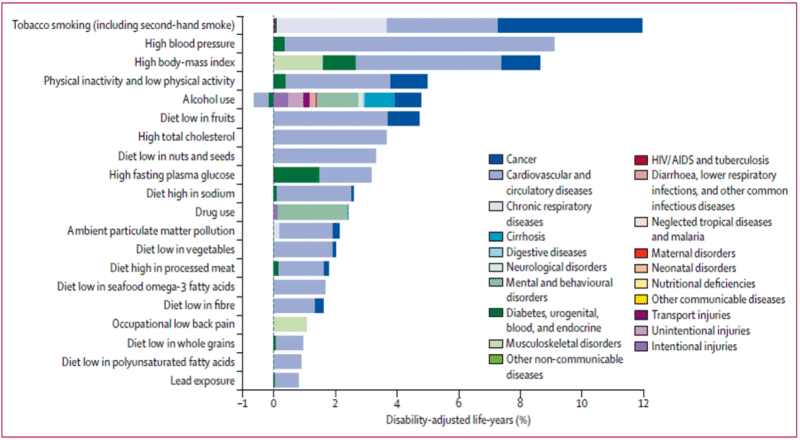
Everyone has a role to play in reducing the harms caused to our society by smoking. Smoking is the leading cause of preventable illness and premature death in the UK killing more than 200 people each day in England alone. This totals more than suicide, diabetes, alcohol and drug related deaths, road traffic and all other accidents put together.

UK burden of disease attributable to 20 leading risk factors for both sexes in 2010 (DoH, 2014)

Half of all smokers will die prematurely from their addiction and on average, die 10 years younger than non-smokers. (Source: ASH Factsheet: “Fact at a glance – key smoking statistics” September 2018)

Smoking in pregnancy

Workers in Children’s Centres and Early Year Settings will come into contact with pregnant women and new mums. Protecting a baby from tobacco smoke is vitally important to give the child a healthy start in life.

Nationally 10.6% of pregnant women still smoke and in Devon this figure is 12.3%. Smoking in pregnancy can restrict the essential oxygen supply to the unborn baby and cause the baby’s heart to work much harder – this can increase risk of miscarriage and stillbirth. Smoking during pregnancy has been found to increase infant mortality by about 40%. Smoking in pregnancy can also increase the likelihood of preterm birth and low birth weight – both of which have have been linked to serious longer term health problems including asthma.

Stopping at any stage during the pregnancy will have a positive effect on the unborn baby but stopping smoking early almost entirely prevents damage to the baby.

Baby being held with smoke around

Secondhand smoke (SHS) in the home is harmful to children

  • Cigarette smoke contains over 4,000 chemicals, many of which are known to be carcinogenic
  • Even when the smoke is gone, toxins linger on clothes and furnishings
  • SHS is proven to cause lung cancer, heart disease and stroke in adults
  • There is a strong link to respiratory disease, cot death, asthma attacks and middle ear infections in children
  • Thousands of children under 5yrs are admitted to hospital every year, due to passive smoking
  • Children of smoking parents are more likely to take up smoking themselves

If you wish to find out more about secondhand smoke visit the NCSCT website where you can access a short 30 minute training module on this topic.

Supporting smokers to quit

Watch this short video to learn how you can support smokers to quit.

The Three A’s

In the film clip you have just watched you have seen how you could help smokers that you come into contact with during your day to day work.

Try to remember the components of the Brief Intervention method.

Ask – Identify smoking status

Advise – The most effective way to stop is with personal support and medication

Act – Refer to NHS Stop Smoking Service for advice and support if they are ready. If not ready, leave information with them

Ask

Be alert to using the opportunities you have for raising the issue:

“I wonder, are you smoking at the moment?”

“I know you quit a while back – how’s that going?”

Encourage the client to talk and take the lead. You don’t need to know why or how much they smoke, so don’t get drawn into a long conversation on their reasons.

Advise

“The most successful way to stop smoking is by using personal support and stop smoking medications”

These include different kinds of nicotine replacement therapy (patches, gum, lozenge, mouth spray, inhalator, tabs, strips, nasal spray) and tablets (if over 18 and not pregnant). All are available on prescription.

Act

If they are ready to stop smoking now: refer them the Local Stop Smoking Service.

If they are content to stay smoking: Leave information for them about the Local Stop Smoking Service in case they change their minds at a later date.

Stop Smoking Services in Devon

Local Stop smoking services (SSS) provide free support across Devon to smokers who would like to quit. Anyone wishing to stop smoking now can be referred directly to Stop for Life Devon.

In addition to Stop for Life Devon, smokers can also seek support from practitioners in:

  • Most GP surgeries
  • Many pharmacies
  • Other community locations

All services provide effective methods of support that have been show to have the strongest evidence base. This includes offering a combination of behavioural and medical interventions such as nicotine replacement therapy.

Summary

You have nearly completed this short training session. Please watch this final short clip to remind yourself of Brief Advice and the ‘Three A’s’.

Quick test

You now need to take a very short test which will consolidate your learning and understanding from this training session.

The test takes 2 minutes to complete. On successful completion you will be able to download your certificate.

Take the test now.